


Swing or Sliding? Selecting the Right Door Opening System for Your Space
Choosing the right door opening system is a key decision in an access-control project, but it often happens late in the process or based on assumptions about space and traffic. For facilities managers, installers, office managers, and estates teams, the selection between a swing or sliding door opening system directly impacts safety compliance, reliability, maintenance effort, and how adaptable the system is for future changes.
This article focuses on selecting the right door opening system for real-world applications, not ideal layouts. We’ll explore how swing and sliding door operators behave in daily use, where each system works best, and where issues tend to arise post-installation. The decision sits alongside other critical elements in an access-control setup, such as intercoms, credentials, and locking hardware. Readers are assumed to have general knowledge of access-control systems and are seeking to avoid costly rework, user complaints, or future limitations.
How Swing and Sliding Door Opening Systems Work in Practice
Swing Door Opening Systems
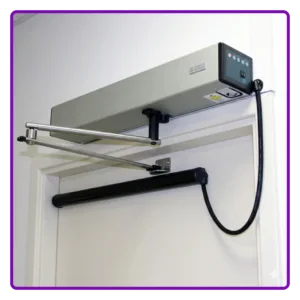
Swing door opening systems automate hinged doors, typically swinging inwards or outwards along a fixed arc. They are commonly used on pedestrian entrances, internal office doors, and accessible routes.
In practice, swing door operators are mechanically simple and integrate easily with access-control devices such as readers, exit buttons, and intercom relays. They are generally tolerant of moderate misalignment and are often easier to retrofit.
However, swing doors require clear space on the opening side, which must remain unobstructed during daily use. Furniture movement, bins, or queuing can cause issues over time if the space is not properly maintained.
Sliding Door Opening Systems
Sliding door opening systems move the door leaf laterally along a track. These are ideal for high-traffic entrances, vehicle gates, and locations where swing clearance is limited.
Sliding systems can handle heavier leaves and higher-duty cycles more comfortably, but they demand precise installation. Track alignment, ground conditions, and safety sensors are critical, and even small shifts in the surface or frame can impact performance.
From an access-control perspective, sliding doors require additional safety devices such as infrared or microwave sensors.
When a Swing Door Opening System Makes Sense
Swing operators are best suited for environments with moderate pedestrian flow and where compliance and accessibility are top priorities. Common use cases include:
- Office internal doors and controlled corridors
- Staff entrances with predictable usage
- Accessible routes requiring controlled opening force
- Retrofit projects with minimal structural changes
Swing doors are generally easier for estate teams to manage over time. Parts availability is broad, and fault symptoms are usually localized and visible. However, they may not be ideal in tight spaces. In narrow lobbies or escape routes, swing doors can conflict with fire strategies or disrupt normal circulation.
When a Sliding Door Opening System is the Better Option
Sliding operators are more suitable for entrances where space in front of the door must remain clear, or where traffic volume is high. Typical use cases include:
- Main building entrances
- Vehicle access points and loading areas
- Sites with trolleys or wheelchairs in frequent use
- External doors exposed to wind pressure
Sliding doors handle constant use better but require more careful planning. Power supply routes, drainage, and long-term ground movement all affect their reliability.
Common Assumptions That Cause Problems Later
One common mistake is selecting a swing operator due to its lower initial cost, without considering clearance conflicts once the building is in use. Another common issue is specifying sliding doors for external use without factoring in drainage or debris affecting the opening.
Safety and Compliance Considerations
Both swing and sliding door opening systems must support safe exit at all times. Emergency releases, break-glass units, and free egress must function independently of automation status.
Ultimately, compliance responsibility falls on the building operator and the installer, so clear documentation and a proper handover process are critical.
Cabling, Power, and Environmental Exposure
Swing & sliding operators typically draw low peak power and can be powered from nearby circuits.
Environmental exposure also matters. Sliding doors may be subject to water ingress, dust, and temperature variations, all of which affect reliability. In contrast, swing doors mounted indoors are better protected but are still vulnerable to misuse. Planning cable routes early is crucial, as retrofitting additional safety devices can be disruptive and costly.
Impact on Day-to-Day Management
From a facilities management perspective, swing door opening systems are simpler to monitor and maintain. Faults tend to be mechanical and localized to the operator.
Sliding doors require more frequent inspections, especially with safety devices involved although safety sensors are very reliable they still need checking on the door’s yearly service. Additionally, making changes to the system later (e.g., adding access control or altering traffic flow) is often easier with swing doors than with integrated sliding systems.
How This Fits into the Wider Access-Control System
Door opening systems don’t function in isolation. They interact with activation sensors, intercoms, readers, locking hardware, and safety devices. Selecting the right operator early on ensures that the entire access-control system works harmoniously, avoiding compromises elsewhere.
For readers looking to place this decision in the broader context of an access-control system, the full system overview explains how operators, intercoms, and control logic integrate seamlessly.
Practical Takeaways
- Operator choice impacts safety, reliability, and long-term maintenance more than upfront cost.
- Swing doors are ideal for predictable pedestrian use and simpler long-term management.
- Sliding doors handle high traffic or volume but require more careful planning and maintenance.
- Power, space, and safety devices should be carefully considered before ordering hardware.
Conclusion
In practice, the decision is straightforward. A swing door opening system is the best choice for most internal doors and staff entrances where space allows, pedestrian flow is predictable, and long-term maintenance needs are simple. It is often easier to integrate with access control, simpler to maintain compliance, and more adaptable to changes later on.
A sliding door opening system should be specified when space in front of the door must remain clear, traffic levels are high, or the entrance must accommodate trolleys, wheelchairs, or vehicles. While it excels in busy or constrained environments, it requires thorough planning, especially around safety devices and ongoing maintenance.
In short, choose swing doors for simplicity and flexibility, and sliding doors for high traffic and space control. By making this decision early, you ensure that your door opening system operates reliably, remains compliant, and adapts smoothly as site needs evolve.