


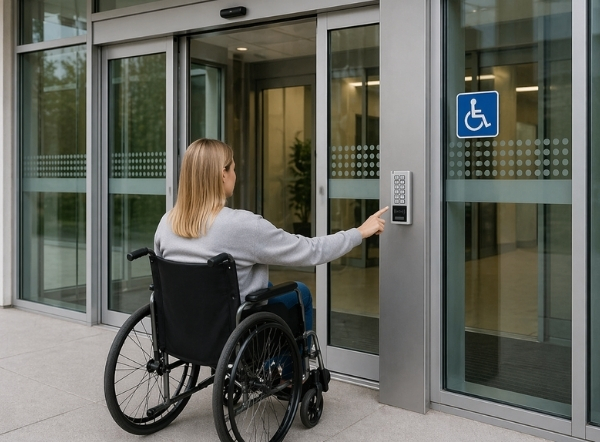
Getting the DDA height for access control right is one of the most important and most commonly overlooked steps in a compliant installation. Mount a keypad or proximity reader too high and a wheelchair user cannot reach it. Get it wrong and you risk breaching Building Regulations Part M and the Equality Act 2010. This guide covers the correct mounting heights, key placement rules, and the most common mistakes installers and facilities managers need to avoid.
What ‘DDA Height’ Means in Practice
The Disability Discrimination Act (DDA) was superseded by the Equality Act 2010, but the term persists across the industry. For access control, the two standards that define compliant mounting heights are:
- Approved Document M (Part M) — the legal minimum for access to and use of buildings in England and Wales
- BS 8300:2018 — the British Standard code of practice for accessible and inclusive built environments, widely used as best practice beyond Part M
Meeting Part M is mandatory for new builds and material alterations. BS 8300 goes further and is the benchmark referenced by architects, access consultants, and auditors.
The Correct DDA Height for Access Control Devices
750 mm to 1000 mm above finished floor level (AFFL) is the accepted operating range for keypads, proximity readers, RFID readers, and exit buttons. Within this range, 900 mm AFFL is widely cited as the optimum centre-height within comfortable reach for most wheelchair users and a natural wrist height for standing adults.
Two device-specific points worth knowing:
- For multi-button keypads, the critical measurement is the top row of keys, not the centre of the unit. If the top row exceeds 1200 mm AFFL, users with limited reach cannot operate the device independently
- For proximity and RFID readers, measure the centre of the read zone rather than the physical centre of the reader body, the read zone typically sits 10-50 mm from the device face
A person using a standard manual wheelchair has a comfortable forward reach of approximately 300–600 mm and a seated eye height of 1000–1200 mm. This is the accessible envelope that BS 8300 mounting guidance is built around. Devices above 1200 mm are effectively inaccessible from a seated position.
DDA-Friendly Activation Placement: Best Practice Principles
- Clear Floor Space
BS 8300 requires at least 1200 mm of unobstructed floor space in front of any operable control. Do not position readers directly behind a gate post, bollard, or door furniture that forces a user to reach at an angle.
- Design for Forward Approach
Always design for forward (front-on) approach as the baseline, it is the most restrictive scenario and you cannot predict how every user will approach an entry point.
- Reader Distance from the Door Leaf
Position readers on the wall 300–500 mm from the latch edge of the closed door. This gives a wheelchair user space to present a credential, wait for the release, and then operate the door without repositioning.
Emergency egress devices must follow the same rules as entry readers: 750–1000 mm AFFL. The return journey must be as accessible as entry. Fitting exit buttons at the ‘elbow height’ of 1400 mm that some electricians default to is a compliance failure.
- Visual and Tactile Contrast
BS 8300 requires a minimum 30-point LRV (Light Reflectance Value) difference between a control and its background wall surface. Tactile indicators on keypads, raised numbers and a tactile marker on the ‘5’ key further support users with visual impairment.

Common Non-Compliance Mistakes
- Mounting ‘to suit standing users’ — positioning readers at 1200–1400 mm AFFL is comfortable for standing adults but excludes wheelchair users entirely
- Measuring to the wrong point — for keypads measure to the top row of keys; for proximity readers measure to the centre of the read zone, not the body of the device
- Ignoring finished floor level — carpet, tiles, or raised access flooring can add 10–50 mm after installation; always measure from the finished floor, not the bare slab
- Gate and pedestrian access — vehicle-height gate keypads must have a secondary activation point at 750–900 mm AFFL wherever pedestrian access is expected
Quick Reference: DDA Mounting Height Summary
Keypads and PIN entry: 900 mm AFFL centre; top row of keys no higher than 1200 mm
Proximity and RFID readers: Read zone centre at 750–1000 mm AFFL
Exit buttons and break glass: 750–1000 mm AFFL; both sides of the door
Intercom call buttons: No higher than 1000 mm AFFL
Roller shutter key switches: 1000 mm AFFL maximum where pedestrian access is present
Gate automation keypads: Dedicated pedestrian point at 750–900 mm AFFL
How Quantek Products Support DDA-Compliant Installations
Quantek’s access control range is designed with real-world installation in mind. Compact keypads, proximity readers, and RFID systems all have a low profile that makes it straightforward to centre-mount at 900 mm without the top of the unit breaking the 1200 mm threshold.
- Exit buttons and break glass units sized for wall-mount within the 750–1000 mm range
- Automatic swing door operators and low-energy operators compatible with accessible activation pads, removing the need for credential interaction in high-accessibility environments
- Disabled toilet locking systems aligned with Part M, including emergency pull cord and indicator bolt positioning
- Installer-friendly designs that allow height adjustment at first fix, reducing the risk of remedial work after handover
- Touch sensitive activation and exit buttons. As no physical press is required these are ideally suited to disabled users.
Frequently Asked Questions
- What is the correct DDA height for an access control keypad in the UK?
The accepted range is 750–1000 mm above finished floor level. 900 mm AFFL is the widely recommended optimum centre-height. The top row of keys must not exceed 1200 mm AFFL.
- Does Part M apply to existing buildings?
Part M applies to new builds and material alterations. The Equality Act 2010 additionally requires service providers to make reasonable adjustments in existing buildings which can include repositioning access control hardware during a refurbishment.
- Do exit buttons need to follow the same DDA height rules?
Yes. Exit buttons, break glass units, and door release pads must be mounted at 750–1000 mm AFFL on both sides of every controlled door. Accessible entry and accessible exit are equally required.
- Need Help Specifying a Compliant Access Control System?
Getting the DDA height for access control right first time protects your clients and avoids costly remedial work. Whether you need a single exit button or a complete multi-door system, Quantek supplies the components and technical knowledge to help you install with confidence.
Conclusion
Getting DDA height for access control right is not just a technical detail but a critical part of delivering safe, inclusive, and legally compliant environments. By following Part M requirements and aligning with BS 8300 best practice, installers can ensure systems are accessible to all users without compromise. From correct mounting heights to thoughtful placement and clear space planning, every detail contributes to usability and compliance. Avoiding common mistakes and designing with real user needs in mind ultimately reduces risk, prevents costly rework, and enhances the overall experience of a building. A well-installed system reflects both professional standards and a genuine commitment to accessibility.