


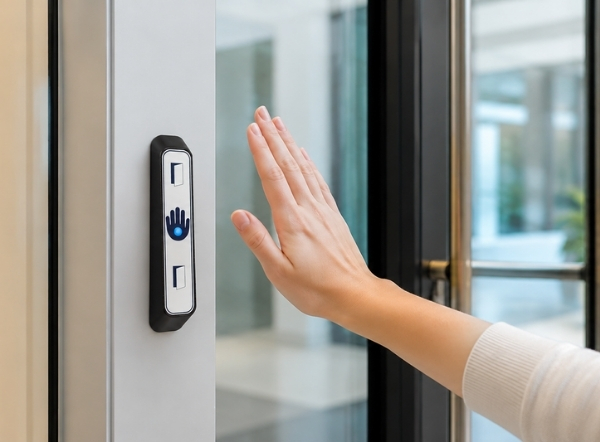
Hygiene has become a central priority in building design and management across the UK. From hospitals and care homes to schools and commercial offices, the way people interact with doors and entry points is under greater scrutiny than ever before. A contactless entry system removes the need to touch shared surfaces at high-traffic access points, reducing the transfer of bacteria and viruses in environments where cleanliness is non-negotiable.
This guide explores how touch-free entry sensors work, the settings in which they are most valuable, the technologies behind them, and how to choose the right solution for your building.
What Is a Contactless Entry System?
A contactless entry system is an access control solution that allows doors to be activated, unlocked, or opened without any physical contact with a handle, button, or keypad. Instead of pressing a surface, users trigger entry through proximity, motion, or credential-based technologies such as RFID cards, fobs, or mobile devices.
The term covers a broad range of products, from passive infrared sensors and microwave motion detectors to radar-based presence sensors and hands-free exit buttons. What they share is the ability to initiate door movement or release a locking mechanism without the user needing to touch anything.
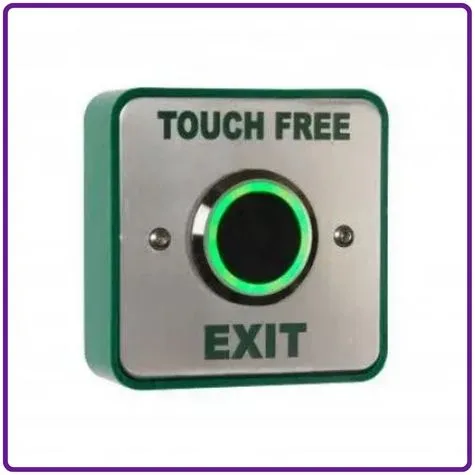
A contactless entry system addresses both infection control requirements and accessibility obligations while complementing wider building access systems such as automatic doors, maglocks, and proximity readers.
Why Hygiene-Focused Access Control Matters
Door handles and push plates are among the most frequently touched surfaces in any building. Research has consistently shown that pathogens can survive on hard surfaces for several hours, making shared touch points a significant transmission risk in busy environments.
Settings where hygiene-focused access control is particularly critical include:
- Healthcare facilities, including hospitals, GP surgeries, and care homes, where infection control protocols are mandated
- Educational buildings, where large numbers of people share common entry points throughout the day
- Food preparation and processing environments, where surface hygiene is a regulatory requirement
- Commercial offices and public-facing reception areas, where visitor footfall is high
- Leisure and sports facilities, where changing rooms and wet areas present additional contamination risks
Beyond infection control, touch-free door sensors also support accessibility. A contactless door entry system that opens automatically or responds to a wave gesture benefits people with limited mobility, those carrying equipment, and anyone whose hands are occupied.
Types of Touch-Free Entry Sensor Technology
Different environments call for different sensor technologies. Understanding the options helps installers and specifiers select the most appropriate solution for each application.
- Passive Infrared (PIR) Sensors
PIR sensors detect changes in infrared radiation caused by the movement of a warm body through their detection zone. They are widely used as activation devices for automatic doors and as presence detectors in access control installations. PIR sensors are cost-effective, reliable, and straightforward to install, making them a practical choice for all environments.
- Microwave and Radar Sensors
Microwave sensors emit continuous microwave pulses and detect movement by measuring the reflection pattern. Unlike PIR sensors, they can detect motion through some non-metallic materials and are less affected by temperature changes in the environment. Radar-based presence sensors offer even greater precision and are increasingly used in healthcare and high-security settings where reliable detection is critical.
- Wave-to-Open Buttons
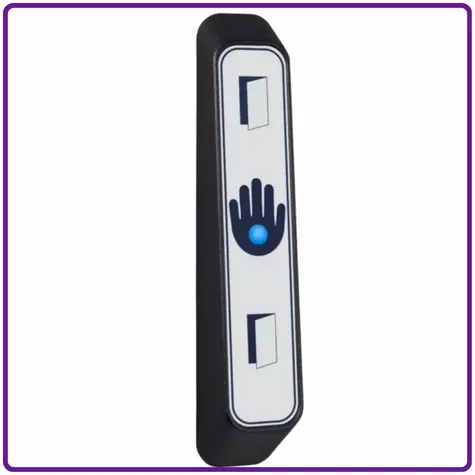
A wave-to-open button uses a short-range sensor to detect a hand gesture in front of a designated activation zone. The user simply waves their hand within range to trigger the door release, with no physical contact required. These devices are easy to retrofit alongside existing automatic door systems and are a popular upgrade in healthcare and hospitality environments moving toward hygiene-first design.
- RFID and Proximity Credential Readers
A contactless door entry system can also be credential-based, using RFID cards, key fobs, or mobile credentials that are presented within a few centimetres of a reader without any physical contact. This approach combines access restriction with hygiene, ensuring that only authorised individuals can enter while eliminating the need to touch shared surfaces. RFID-based contactless entry systems are standard across commercial and industrial access control installations throughout the UK.
- Optical and Foot-Operated Sensors
Optical beam sensors and foot-operated activation pads offer further options for touch-free entry in specialist settings. Foot pads are particularly useful in clinical environments where both hands may be occupied with equipment or where strict glove protocols are in place.
Where Contactless Entry Systems Are Used
A contactless entry system is suitable across a wide range of sectors. The following use cases illustrate the breadth of application for touch-free access control in the UK.
- Healthcare and Care Settings
Hospitals, GP practices, dental surgeries, and care homes require the highest standards of infection prevention. Touch-free door sensors and hands-free entry systems reduce the number of contaminated contact points at ward entrances, operating theatre corridors, and patient-facing areas. Combined with automatic swing or sliding door operators, a fully contactless entry system can be installed in critical zones without disrupting workflow.
- Education
Schools, colleges, and universities manage large volumes of people moving through shared entrances throughout the day. A contactless door entry system at main entrances, fire exits, and internal corridors reduces surface contact while maintaining controlled access. For safeguarding purposes, access credentials can be assigned to staff, with visitors processed through a managed entry point.
- Commercial Offices
Office buildings benefit from touch-free entry at reception areas, meeting rooms, and secure internal zones. Proximity readers and wave-to-open devices can be integrated with existing access control panels to create a cohesive, scalable system. For facilities managers responsible for multiple tenants or floors, a contactless entry system simplifies credential management while improving the hygiene standards of shared spaces.
- Industrial and Warehouse Environments
In warehouses and manufacturing facilities, workers frequently have their hands occupied with materials, tools, or PPE. A hands-free entry system reduces the risk of cross-contamination in food processing or pharmaceutical production and improves flow at high-traffic doors between zones. Rugged sensors designed for industrial environments maintain reliable performance in dusty or humid conditions.
- Retail and Hospitality
Retail units and hotels have both high footfall and a responsibility to provide a welcoming environment for customers. Touch-free activation at main entrances and internal service doors contributes to a cleaner, more accessible customer experience while reducing maintenance needs associated with high-use door furniture.
Compliance and Regulations in the UK
Installing a contactless entry system in the UK must account for relevant building regulations and safety standards. The following frameworks are particularly relevant.
Key regulatory considerations include:
- Approved Document M (Access to and Use of Buildings) requires that buildings are accessible to disabled people. Hands-free or automatic door activation directly supports Part M compliance by removing the need to operate door furniture manually.
- Approved Document B (Fire Safety) governs fire door and exit requirements. Any locking mechanism used in a contactless entry system must be fail-safe in the event of a power failure, releasing to allow evacuation.
- BS EN 60839 covers electronic access control systems, setting out requirements for equipment performance and system design.
- HTM 08-01 (Acoustics) and infection prevention guidance from NHS England inform the specification of touch-free systems in healthcare environments.
Specifiers and installers should verify that products carry appropriate CE or UKCA marking and are tested to relevant standards. Quantek supplies products designed with compliance in mind, supporting installers in meeting regulatory requirements on-site.
Integrating Touch-Free Sensors with Your Access Control System
One of the most practical aspects of modern touch-free door sensors is their compatibility with existing access control infrastructure. Whether upgrading an installation or specifying from scratch, touch-free activation devices can be integrated with a wide range of control panels, locking hardware, and door operators.
Key integration considerations include:
- Power supply compatibility: most sensors operate on 12V or 24V DC and can be connected directly to an existing control panel or power supply unit
- Output type: sensors typically provide a dry contact or relay output that triggers the door controller or lock release
- Timing adjustment: activation delay and hold-open time should be adjustable to suit pedestrian flow and door specification. This can often be adjusted through the access controller.
- Override options: manual override capability ensures the system remains functional during maintenance or sensor fault conditions
- Combined with automatic swing door operators or sliding door systems, a contactless door entry system can provide a fully hands-free passage experience from the exterior to interior of a building
For larger installations with multiple access points, readers can be networked across a building management system, allowing centralised monitoring of door activity and credential management.
Choosing the Right Touch-Free Entry Sensor
Selecting the most appropriate touch-free entry sensor for a project depends on several factors. The following questions help narrow the specification.
Consider the following when specifying:
- What is the primary driver for the installation? If it is infection control, a wave-to-open or fully automatic sensor may be most appropriate. If it is access restriction with hands-free convenience, a proximity reader-based contactless entry system is likely the better fit.
- What is the environment? Indoor sensors with standard IP ratings are suitable for most commercial applications. External or industrial settings may require higher ingress protection ratings to cope with weather or dust.
- What is the traffic volume? High-traffic doors may benefit from dual-sensor activation zones to ensure reliable triggering across the full width of the passage.
- Are there additional accessibility requirements? Where Part M compliance is a specific objective, ensure the activation zone is positioned at an appropriate height and distance for wheelchair users.
Conclusion
Touch-free entry sensors have moved from a specialist product into a mainstream requirement across the UK. A well-specified contactless entry system reduces the risk of surface-based infection transmission, supports accessibility compliance, and integrates seamlessly with broader access control infrastructure. Whether the priority is infection control in a healthcare setting, accessibility in a public building, or operational efficiency in an industrial facility, there is a touch-free solution suited to the application.
From RFID-based contactless door entry systems to PIR-activated automatic door operators, the technology is reliable, installer-friendly, and available in configurations to suit virtually any door type or environment. Hands-free entry has also moved from a desirable feature to an expected standard in many sectors, making early adoption a sound investment for building owners and facilities managers alike.
At Quantek, we supply a wide range of touch-free door sensors, activation devices, and access control components to support hygiene-focused installations across the UK. If you are specifying a new contactless entry system or upgrading an existing installation, get in touch with our team to discuss the right solution for your project.