


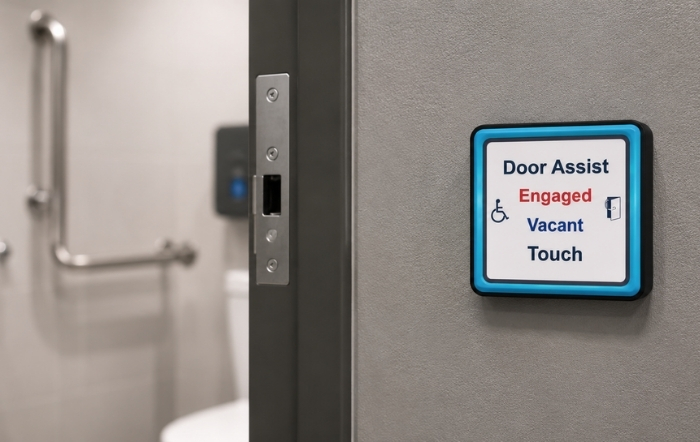
If you manage a commercial building, design accessible washrooms, or specify door hardware, you have probably come across conflicting information about disabled toilet door lock regulations. What exactly does the law require? What does it recommend? And what are the common assumptions that simply are not true?
This guide pulls together the key regulations in one place, cuts through the confusion, and tells you what you actually need to specify.
The Regulatory Framework: Which Rules Apply?
Disabled toilet door lock regulations in England are set by a combination of legislation, building regulations, and British Standards. They do not operate in isolation.
The Equality Act 2010 is the overarching law. It places a duty on building owners and service providers to make reasonable adjustments so that disabled people can access facilities on the same basis as everyone else. It replaced the Disability Discrimination Act 2005 (DDA), though you will still see the term “DDA compliant” used across the industry as shorthand for accessibility compliance.
Building Regulations Approved Document M (Volume 2, for buildings other than dwellings) sets the minimum legal requirements for accessible toilet design, including doors and locking hardware. The 2024 amendments updated several provisions, and compliance is assessed through building control.
Approved Document T, which came into force in June 2023, is a newer addition specifically covering toilet provision in non-domestic buildings. It consolidates and updates guidance previously scattered across Document M and requires at least one unisex wheelchair-accessible toilet in any non-domestic building where toilet facilities are provided.
BS 8300-2:2018 is the British Standard that provides detailed guidance on accessible and inclusive building design. While it is not itself a legal requirement, Document M endorses it, meaning following BS 8300 is widely understood as the appropriate way to demonstrate compliance. Failure to follow it can expose building owners to complaints, legal action, or injury liability.
Together, these documents define what a compliant disabled toilet door lock must do.
What the Regulations Actually Require
One-Handed Operation, No Twisting or Gripping
This is the clearest requirement across all three documents. Any lock, latch, or bolt fitted to a disabled toilet door must be operable with one hand, using a closed fist, without any need to twist, grip, or pinch.
As the East Sussex Building Control Partnership guidance confirms, door furniture “should allow the door to be opened with a closed fist; therefore lever style door handles are preferable.”
This rules out standard turn-and-release knobs, small thumbscrews, and any lock mechanism that requires fine motor control. Lever action handles should be used wherever possible, and light action privacy bolts are specified by Document T for cubicles and toilet rooms.
Emergency Release from the Outside
All disabled toilet doors must include an emergency release mechanism operable from outside the cubicle or room. This applies whether the door opens inwards or outwards.
The reason is straightforward: if a user collapses against the door, assistance must be able to reach them.
This is a hard requirement across Approved Document M, Document T, and BS 8300. It is non-negotiable.
Occupied/Vacant Indication with High Visual Contrast
Every accessible toilet should provide a clear visual indication of whether it is occupied or vacant. This is not simply courteous. For users with visual impairments, low-contrast indicators present a genuine access barrier.
BS 8300-2:2018 recommends using the words “Vacant” and “Occupied” alongside a colour-changing indicator. However, the specific wording is not mandatory under any current regulation. What is required is that the indicator provides sufficient contrast to be distinguishable by people with visual impairments.
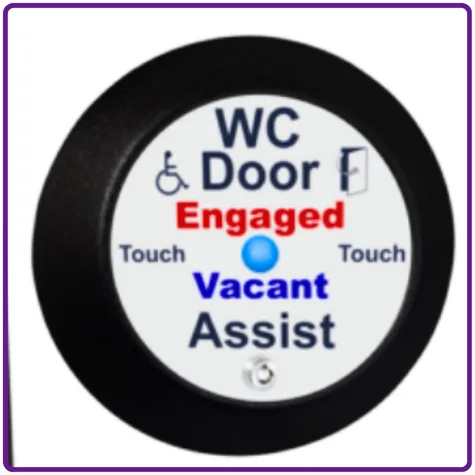
One common misconception is that indicators must be red and white. There is no specific legal requirement for those colours. What the regulations require is adequate visual contrast. Red and blue are frequently used instead of red and green, because red-green colour blindness is common and the two colours are too similar in hue to be reliably distinguished by many users.
Light Reflective Value (LRV) and Visual Contrast
Door hardware and associated fittings should contrast visually with the door and wall surfaces they are fitted to. BS 8300 specifies a minimum difference of 30 LRV (Light Reflective Value) points between hardware and background surfaces. This applies to handles, lock mechanisms, and indicator panels alike.
Specifying hardware in brushed stainless steel against a white or light-coloured door, for example, will typically achieve the required LRV difference.
What the Regulations Do Not Require
A few persistent myths are worth addressing directly.
Red and white indicators are not legally required. The regulations focus on adequate visual contrast, not specific colours. Red and blue, or other high-contrast combinations, are fully acceptable.
Braille on lock hardware is not mandatory. A 2024 survey by the Royal National Institute of Blind People found that around eight percent of registered blind or partially sighted people use braille. While including braille can enhance independence for those users, it is not required by any current disabled toilet door lock regulation.
DDA is no longer the governing law. The Disability Discrimination Act was repealed and replaced by the Equality Act 2010. Documents and products still described as “DDA compliant” typically mean they are designed to meet current accessibility standards, but the legal basis is now the Equality Act.
The RADAR Key Scheme
The RADAR Key Scheme, officially the National Key Scheme (NKS), allows disabled people to access locked public toilets independently using a standardised key. All participating venues use the same lock, meaning a single key opens accessible toilets across the UK.
Using NKS locks helps venues manage anti-social use of accessible facilities without preventing legitimate access. It is not discriminatory to protect accessible toilets in this way, provided the lock meets the ease-of-use requirements above and does not act as a barrier to those who need the facilities.
Electronic RADAR systems take accessibility a step further, offering easy quarter-turn access alongside touch-free sensor-operated locking and unlocking. These systems remain compatible with standard RADAR key entry while providing contactless internal locking for users with limited dexterity. They can also be integrated with automatic doors, significantly improving ease of use and the overall user experience
Practical Considerations for Specifiers and Facilities Managers
When specifying a disabled toilet door lock, the checklist should cover:
- One-handed, closed-fist operation for all locking and unlocking functions
- Emergency external release via coin slot, specialist key, or external override mechanism
- High-contrast occupied/vacant indicator with at least 30 LRV points difference from its background
- Touch free buttons, electronic locking and automated doors – rather than knobs or round pull hardware
- Emergency assistance alarm with a pull cord reaching to within 100mm of floor level (required separately under BS 8300 and Document M)
- Door width of at least 800mm clear opening, with 825mm preferred for wheelchair users
For venues installing or upgrading a public accessible toilet, an electronic system that combines sensor operation, LED status indicators, and emergency override in one unit simplifies compliance considerably.
Compliant Disabled Toilet Locking Systems from Quantek
At Quantek, we supply a comprehensive range of Disabled Persons Toilet Systems (DPTS) designed not only to meet regulatory requirements above, but to exceed them — delivering the level of accessibility, usability, and independence we believe users should expect.
Our Contactless Toilet Door Kit uses touch-free sensors activated by a simple wave of the hand, making it particularly suitable for users with significant dexterity limitations. No physical contact is required, and the sensor activation range can extend up to 70mm. To better support users with colour vision impairments, the system features bright red and blue LED status indicators instead of traditional red and green. The system can also be integrated with automatic door operators, enabling a fully touch-free user experience from entry to exit. No more struggling to open and close the door or manually lock the door. This solution is trusted in high-profile environments, including the House of Commons, House of Lords, and Heathrow and Gatwick airports.
For public-access venues requiring controlled entry, our RADAR Toilet Door Kit combines a weatherproof RADAR key entry switch with an internal touch-to-lock sensor. The door remains securely locked when unoccupied, with a blue LED clearly indicating availability. Once inside, users can lock the door with a single touch, automatically preventing external access until they exit. Integration with automatic door systems can further enhance accessibility, simplifying operation for users with reduced mobility or dexterity.
The Quantek DPTS Disabled Persons Toilet Locking Systems range hardwired, radio, and bespoke systems, making it suitable for both new installations and retrofit projects. All systems include emergency override functionality and are compatible with manual doors or existing and new automatic door operators, allowing seamless integration into a wide range of washroom environments.
For projects requiring individual components, our Internal WC Sensors and Architrave Touch to Lock sensor can be integrated into existing installations, automatic door systems, or bespoke access control setups.
If you are unsure which system suits your site, call us on 01246-417113 or email [email protected]. We can advise on compliance requirements and specify the right hardware for your installation.